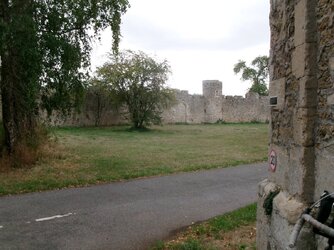
Castle Pulverbatch - one of my all time fave castles.
This potted history is from the heritage listing.
"The monument includes Castle Pulverbatch motte and double bailey castle situated at the northern end of a small steep sided ridge overlooking to the north east the village of Pulverbatch set in a small valley, through which the natural valley route from Shrewsbury to Bishops Castle once ran. The manor was held by Roger Venator in 1086 and it is possible that he was responsible for the construction of the castle, though it is not until 1153 that the castle is first mentioned in texts of the period. By 1202 the castle, although still in existence, had been deserted and was falling into disrepair. The castle earthworks include a castle mound or motte, roughly circular in plan with a base diameter of 35m standing up to 8m high. The motte has been constructed on the edge of the ridge to make maximum strategic use of the natural topography. Although there is now no trace of any masonry on the motte there is a local tradition that stonework formerly existed on the site. A substantial ditch, 7m wide and 2.6m deep, with a counterscarp bank 4m wide and 0.8m high separates the castle motte from the flat ground to the west. Around the east and south east sides of the motte no ditch is visible and it may be that the steep natural slopes, which fall to the south east, provided sufficient defence. There are two conjoined baileys designed to contain and protect the domestic buildings of the castle. The smaller, inner bailey lies on the north east side of the motte and a larger outer bailey lies to the north west. The inner bailey lies adjacent to the motte and is rectangular in plan with internal dimensions of 28m north east to south west by 30m transversely. Around its north west and north east sides the bailey is defended by a substantial bank approximately 10m wide and 4.2m high on its outside, 1.5m high on its inside. Around the south east side the natural hillslope has been cut back to create a steep scarp slope above the natural approach to the castle. A ditch 6m wide and 1.2m deep runs for approximately 40m along the western side of the north east bailey, turning into the bailey rampart at its southern end short of the motte ditch, to allow passage between the inner and outer baileys. A similar section of ditch runs for 30m parallel to the north east section of rampart. A large pit 6m in diameter and 1.2m deep lies in the south west sector of the north east bailey, adjacent to the motte ditch. The outer bailey lies adjacent to the motte on its north west side and is roughly triangular in shape with internal dimensions of 80m north to south by 40m east to west. It is defended by a bank up to 6.5m wide and 1.4m high along its north west side and by a scarp 2.2m high along its south west side. A ditch up to 5m wide and 1m deep runs along the outside of both bank and scarp. Around the northern side of the enclosure the bailey rampart lies adjacent to the modern roadway; a section of the rampart at the northern corner of the site is crossed by a trackway leading into the interior of the site."
The motte