Smart watches for heart issues

Page may contain affiliate links. Please see terms for details.
Anyone have a recommendation for a smartwatch that will detect heart arrhythmia, atrial fibrillation etc? I've googled it but just wondering if anyone had any direct experience. I'm getting the odd palpitation and would like some data as the doc doesn't think I need a 24hr ECG or anything.
 

Webbo2

Über Member
Anyone have a recommendation for a smartwatch that will detect heart arrhythmia, atrial fibrillation etc? I've googled it but just wondering if anyone had any direct experience. I'm getting the odd palpitation and would like some data as the doc doesn't think I need a 24hr ECG or anything.

Ask for a second opinion or pay for a private ECG which will be far accurate then any smart watch and might be cheaper.
 

nogoodnamesleft

Active Member
I had a Garmin watch a yr or 2 back, top of their range model. Got it for cycling not arrhythmia and although it was advertised as detecting arrhythmia that was actually only in US and blocked other countries.

Bute en recording heart rate on a cycle ride it was worse than useless. I'd find after 20 miles pushing effort my HR would be down at levels I see watching TV in evening. So I'd really push for a bit yet HR stayed way down. Found a Polar chest sensor very cheap so tried thatat same time and Garmin was just making up numbers and Polar was giving more sensible believable data that reflected my efforts /breathlessness even fingers on wtist.

After a couple of months and many arguments with Garmin I sent it back for full refund asnothing more than a useless toy.

So a recommendation as to what not to get.
 

presta

Legendary Member
AFAIK, the Alivecor Kardia monitor is the only one that the NHS have approved and accept, so if your phone supports it (remember to check before you buy), then I'd be inclined to go for that, otherwise they'll still have an excuse to reject it. If it's AF you're looking for you need an electrical monitor, the infrared ones are not reliable (IME).
 

Mo1959

Legendary Member
Just did a quickie on my Apple Watch. I’m sure it’s not foolproof, but it gives you a little bit of reassurance. Not that I have ever noticed any weird heart beats anyway.


IMG_0429.png
 

nogoodnamesleft

Active Member
If you are getting occasional palpitations then things like kardia won't be much help as look like you start a test and 1 min (or whatever short period later) stop the test. Chances of you doing the test at the same time as a palpitation probably slight.

My non medical understanding is that palpitations are not uncommon so proving to GP you have them occasionally might mean nothing (ie you as well as most other people). Consider what you are trying to achieve. But I emphasise I'm not a medic so above is my thoughts and non-medical understanding.
 

tom73

Guru
Location
Yorkshire
AFAIK, the Alivecor Kardia monitor is the only one that the NHS have approved and accept, so if your phone supports it (remember to check before you buy), then I'd be inclined to go for that, otherwise they'll still have an excuse to reject it. If it's AF you're looking for you need an electrical monitor, the infrared ones are not reliable (IME).

NICE only recommend It as an option for detecting atrial fibrillation (AF) for people with suspected paroxysmal AF, who present with symptoms such as palpitations and are referred for ambulatory electrocardiogram (ECG) monitoring by a clinician. In other words they believe it's a cost effect way over a standard 24hr monitor for patients to manage ongoing condition under the direction of a clinician. They are also at pains to point out any reading via the device must be read and interpreted by a clinician.
Not a device for the worried well adding even more work to massively over worked primary care.
 

vickster

Squire
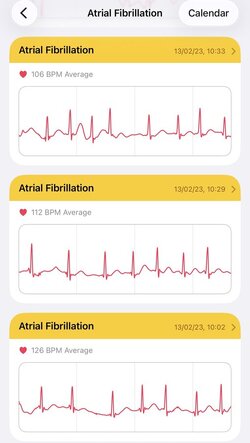
I discovered my AF thanks to my Apple Watch, the electrophysiologist was very happy to have the readings as shown above as it was intermittent. It was only captured on monitor in A&E resus but sadly they didn't have a print out. Although the readings did tally closely to the watch at the time. The two week ambulatory
Monitor I had fitted did not capture.
Following the ablation last year, I still monitor weekly AF activity.
Other makes may have a similar facility but Apple is recognised as a tool to collect data for medical opinion.

These were the first few that caused me to contact an anaesthetist friend who told me to get seen asap (I was 10 days post knee arthroscopy and she was concerned about a DVT!)
I measured on the watch as my heart rate felt/ was very high despite just being sat on the sofa that morning!
My episodes could last from minutes to hours!

My care was all through work Bupa (as was the knee op) so no involvement of primary care at any stage (actually I had one GP appointment to discuss medication prescription). Having seen the bills for 9 months for all the appointments, tests, ablation, cost a pretty penny even at insurer rates.
I did have a couple of trips to A&E, including a cardiac CT to rule out clot in heart (legs were clear)

 

Attachments

  • IMG_1504.jpeg
    IMG_1504.jpeg
    50.7 KB · Views: 0
Last edited:

nogoodnamesleft

Active Member
My own non-medical (so no advice) understanding is that there are a wide range of things that can cause arythmias eg hiatus hernias (research shows even fairly small ones), vagus tone, even for some lying down on your left side (so turn over and it stops), etc.

They are also at pains to point out any reading via the device must be read and interpreted by a clinician.
I think this is far more significant than any standard "see your Dr" type comment. I had an ECG some time back for something unrelated (ir was a precautionary check prior to some other procedure and I wasn't expecting it) and the nurse commented that some signal was early and whilst "abnormal" it was within the tolerance for "acceptable".
 
Last edited:

tom73

Guru
Location
Yorkshire
My own non-medical (so no advice) understanding is that there are a wide range of things that can cause arythmias eg hiatus hernias (research shows even fairly small ones), vahus tone, even for some lying down on your left side (so turn over and it stops), etc.


I think this is far more significant than any standard "see your Dr" type comment. I had an ECG some time back for something unrelated (ir was a precautionary check prior to some other procedure and I wasn't expecting it) and the nurse commented that some signal was early and whilst "abnormal" it was within the tolerance for "acceptable".

Totally what most don't understand is most of a HCP's job happens without anyone knowing about. What they don't see is the thought process a list of test results or set of of Obs is just that. Knowing and seeing the bigger picture is what leads to a clinical outcome.
 

siadwell

Guru
Location
Surrey
A Kardia device carried in the pocket will give you high quality recordings when you feel irregularities.

My (19yo) daughter has episodes where her HR rockets up to 200+, the max indicated by her Apple watch. She had a couple of ECGs done, including one for 48 hours or more, but nothing happened whilst she was wearing it and the doctor had nothing to go on. So we bought a Kardia and she's managed to record a couple of episodes that have been sent to the consultant.
 

Bonefish Blues

Banging donk
Location
52 Festive Road
My (19yo) daughter has episodes where her HR rockets up to 200+, the max indicated by her Apple watch. She had a couple of ECGs done, including one for 48 hours or more, but nothing happened whilst she was wearing it and the doctor had nothing to go on. So we bought a Kardia and she's managed to record a couple of episodes that have been sent to the consultant.

Exactly this - I went to A&E with a lengthy AF episode and as if by magic it stopped* the moment they wired me up, so I emailed them several Kardia traces I'd previously recorded. I've also used my Withings watch on occasion, just because it was to hand (well wrist) and there was sufficient resolution to be helpful, I was told.

*The episode, not me bleedin' heart, obvs!
 

presta

Legendary Member
NICE only recommend It as an option for detecting atrial fibrillation (AF) for people with suspected paroxysmal AF, who present with symptoms such as palpitations and are referred for ambulatory electrocardiogram (ECG) monitoring by a clinician. In other words they believe it's a cost effect way over a standard 24hr monitor for patients to manage ongoing condition under the direction of a clinician. They are also at pains to point out any reading via the device must be read and interpreted by a clinician.
Not a device for the worried well adding even more work to massively over worked primary care.

My point is that if you use a monitor that the NHS don't recognise they'll have a ready made excuse to ignore it if that's what they want to do.

I had two Bruce (treadmill) tests, two 24hr Holter monitors (ambulatory EGC recorders), a 7 day Holter, and more ECGs than you can poke a stick at, but the only times they ever saw my arrhythmia were the other ten occasions I fetched up at A&E in an ambulance. Having a monitor of your own isn't guaranteed to catch it, but it's a shifting the odds a considerable way in your favour.
 
Top Bottom