First time chain replacement

Page may contain affiliate links. Please see terms for details.
I wouldn't worry too much about the differences between the two above both are reputable chain makers.

To make life easier for cleaning and future replacement/removal, I would advise that you purchase and install a quick link if you don't already have one. Apart from anything else, the make life easier if you want to remove the chain for cleaning. This would suffice: https://www.amazon.co.uk/KMC-Unisex...33802-B07J2TXG5J-&hvexpln=0&gad_source=1&th=1

As far as getting the length, its probably easiest to count the links on your existing chain (but allow the the extra quick link you will be putting in) or calculate using the following method: https://www.google.com/search?q=chain+length+equation+9+speed&sca_esv=aaedd9f10623a379&rlz=1C1VDKB_enGB1123GB1123&sxsrf=ANbL-n7qIpedQVX_-oCZsZoyPMi1n1YJ0w:1771859422571&ei=3m2cafbNIr3XhbIP2NWr4Qc&oq=chain+length+equation+9+s&gs_lp=Egxnd3Mtd2l6LXNlcnAiGWNoYWluIGxlbmd0aCBlcXVhdGlvbiA5IHMqAggBMgUQIRigATIFECEYoAEyBRAhGKABMgUQIRigATIEECEYFTIFECEYnwVIpDxQsQdYhCRwAngAkAEAmAGAAaABkAWqAQMxLjW4AQHIAQD4AQGYAgegAuUEwgIKEAAYsAMY1gQYR8ICBhAAGBYYHpgDAIgGAZAGCJIHAzIuNaAHvx2yBwMwLjW4B9gEwgcFMC4xLjbIBxyACAA&sclient=gws-wiz-serp#fpstate=ive&vld=cid:c475f2f1,vid:Vg2SoOOrpE8,st:221

You will also need a chain breaker (to remove your existing chain if it doesn't have a quick link and to shorten your new chain to the correct length. Something like this: https://winstanleysbikes.co.uk/park...RhyrL9Y-QgXlRpRQe1_s0hT6c1zEbpVRoCzCMQAvD_BwE

Make sure you thread the chain through the transmission system properly MAKING SURE THE CHAIN GOES THROUGH THE RIGHT SIDE OF THE TAB ON THE REAR DERAILLEUR (have a look at where the chain is before you remove it - it may even be worth taking a photo of the existing chain through the derailleur before you take it off).

Hands will probably get very oily so nitrile gloves might be worth considering.

OP said he has a master link tool.
+1 for take a photo of derailleur threading
 
OP
OP
BikerBob38

BikerBob38

Member
Location
Maryland
To all - I searched for how to count links in a bike chain and found this video:
www.youtube.com/watch?v=QHt8FXdWsL8 2

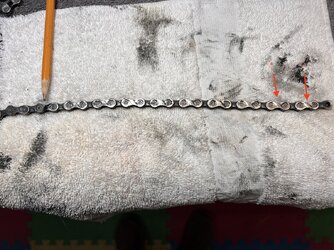
Using his method counting '2' for the link the first arrow points to, '4' for the next and so on to the last link in the chain, I come up with 118 links.

This is the KMC chain I found on Amazon and it has only 114 links.

https://www.amazon.com/gp/product/B07J38GX7L/ref=ox_sc_act_title_1?

Is the video wrong or is there something wrong with the way I am counting links???
 

Attachments

  • IMG_5806.JPG
    IMG_5806.JPG
    324.6 KB · Views: 0
OP
OP
BikerBob38

BikerBob38

Member
Location
Maryland
Since I had the necessary measurements...

• largest chainring tooth count = 36 teeth
• largest cassette cog tooth count - 36 teeth
• chainstay length (or the bike model) - From Trek site: 470mm

...I used this formula to compute chain length and it returned: Your correct chain length: 112 links and I went ahead and ordered the KMC X9 9 Speed Chain, Silver/Grey, 122 Link and will next order a chain-breaker tool.
 
Since I had the necessary measurements...

• largest chainring tooth count = 36 teeth
• largest cassette cog tooth count - 36 teeth
• chainstay length (or the bike model) - From Trek site: 470mm

...I used this formula to compute chain length and it returned: Your correct chain length: 112 links and I went ahead and ordered the KMC X9 9 Speed Chain, Silver/Grey, 122 Link and will next order a chain-breaker tool.

Get a good quality chainbreaker, as you should with all tools.
 

roubaixtuesday

self serving virtue signaller
Err, that's nonsense.
Unless there is elasticity in the metal used (there isn't).
Chain wear is the rollers becoming thinner - the side plates can't and don't stretch - there not made of rubber.

If you hang a new and old chain next to one another, the old chain is, indeed shorter.

Because of the wear you refer to.

[Edit, should of course read the *new* chain is shorter! Doh! ]
 
Last edited:

ColinJ

Puzzle game procrastinator!
Err, that's nonsense.
Unless there is elasticity in the metal used (there isn't).
Chain wear is the rollers becoming thinner - the side plates can't and don't stretch - there not made of rubber.
Er, I didn't say anything about side plates stretching!

But you are still wrong; not just slightly wrong - comprehensively wrong!! :laugh:

If you had ever placed a worn chain next to a new one it would have been very obvious how much longer the worn one was for a given number of links.

Chain wear tools work by showing that the prongs can squeeze in where they shouldn't be able to, because the chain rivets and/or rollers are worn.

Watch this...

 
OP
OP
BikerBob38

BikerBob38

Member
Location
Maryland
It sounds very wrong.

Use this -

https://rollmassif.com/chain-link-calculator/

Chainstay length is from centre of bottom bracket to centre of rear wheel axle.

I have run into a problem.
when I use the online calculator it returned I needed a chain with 114 links.
I found the formula for making the calculation and had Copilot.AI and Perplexity.AI each run the formula using the same inputs as the chain-link-calculator and they both returned 112 links.
Any thoughts on this discrepancy??

Here was the Perplexity.ai calculation:
Screenshot 2026-02-24 at 07.36.23.jpg
 

roubaixtuesday

self serving virtue signaller
I have run into a problem.
when I use the online calculator it returned I needed a chain with 114 links.
I found the formula for making the calculation and had Copilot.AI and Perplexity.AI each run the formula using the same inputs as the chain-link-calculator and they both returned 112 links.
Any thoughts on this discrepancy??

Here was the Perplexity.ai calculation:
View attachment 800960

Thoughts? That you have too many. You're over thinking it to a quite alarming extent.

Just replace it with one the same length.
 

Ajax Bay

Guru
Location
East Devon
have to assume that it was the correct length when originally installed.
No need to assume. Before removing old chain shove it in large-large and if the chain is the correct length the RD cage will point 'below' 4 o'clock. If it points after 6 o'clock, the chain is probably too long.
I know (having fitted current chain) that its length is correct so I lay the old and new chains down and cut. The elongation is less than 0.75% so for a 57 (one inch) link chain that's an 11mm elongation: easy to ID the link to cut. I recommend you don't use 'calculators': too many opportunities for error.
NB Chains don't "stretch" inelastically, they elongate through wear.
Unless there is elasticity in the metal used (there isn't).
There IS elasticity in the sideplates (steel) but the nano-strain under tension returns to 0.
But from the OP, think you just have a quick-link squeezy tool so establish the number of links, buy from a shop and get them to cut it. Finally, don't throw the old chain away until you've road tested (put power through on a middle sprocket) the new chain. The 'chain checker' may suggest you're replacing it before it's "too worn" but . . . The old chain on the current cassette will soldier on for a couple of thousand more miles

Having had three different KMC fail on me (fractured sideplates, all caught during oiling pre-ride) I now abhor and use SRAM.
 
Last edited:

T4tomo

Legendary Member
@BikerBob38
keep it simple,
chain same length as one you are taking off - study your photo for routing and make sure you get the chain the right side of the little tab thing on the rear derailleur upper jockey wheel, that's about the only place you can go wrong.

quick link pliers are good for removing old and fitting new one (think u said you had) . As the old chain is factory fit, it just might just need to push a pin out of it to break it.
 

Bristolian

Über Member
Location
Bristol, UK
Er, I didn't say anything about side plates stretching!

But you are still wrong; not just slightly wrong - comprehensively wrong!! :laugh:

If you had ever placed a worn chain next to a new one it would have been very obvious how much longer the worn one was for a given number of links.

Chain wear tools work by showing that the prongs can squeeze in where they shouldn't be able to, because the chain rivets and/or rollers are worn.

Watch this...


Dorset Boy is exactly right and what you wrote is no different.
 
Top Bottom