
You are using an out of date browser. It may not display this or other websites correctly.
You should upgrade or use an alternative browser.
You should upgrade or use an alternative browser.
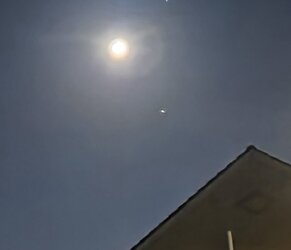
Stargazers......What is this star ? (The one below the moon)
- Thread starter Dave7
- Start date
Page may contain affiliate links. Please see terms for details.


dicko
Legendary Member
- Location
- Derbyshire
Saturn I think? Happens this time every tear.

Alien8
Senior Moment
- Location
- (A little bit north of) Cambridge
Jupiter ... and H&I has an astronomy thread: https://www.cyclechat.net/threads/the-amateur-astronomy-thread.273938/
dicko
Legendary Member
- Location
- Derbyshire
Yes I confirm it’s Jupiter.

Last edited:

wheresthetorch
Dreaming of Celeste
- Location
- West Sussex
Is there a more appropriate section for this question?
Google is giving me various answers/options. I won't put them here so as not to misleading anyone.
Thanks.
View attachment 796961
Rather than Google, download a free app called Stellarium - will show you the night sky at any location and time.
nogoodnamesleft
Active Member
If you have a pair of binoculars try seeing the 4 larger mpoons of Jupiter (4 Galilean moons). Easy to recognise as they form a line normally either side of Jupiter. You might not spot all 4 given they are orbiting Jupiter so move behind the planet or transit across the front (harder to notice).
Min 7x50 binoculars. Can hand held but easier to find something to rest them on.

Min 7x50 binoculars. Can hand held but easier to find something to rest them on.
If you have a pair of binoculars try seeing the 4 larger mpoons of Jupiter (4 Galilean moons). Easy to recognise as they form a line normally either side of Jupiter. You might not spot all 4 given they are orbiting Jupiter so move behind the planet or transit across the front (harder to notice).
Min 7x50 binoculars. Can hand held but easier to find something to rest them on.
View attachment 797012
Thanks. If weather is clear I will try that later.
NB
My bins are 8x42 so should be fine.

MontyVeda
a short-tempered ill-controlled small-minded troll
- Location
- Lancaster... the little city.
If it's that big and white and bright, in the middle of the night... it's almost always going to be Jupiter.

gbb
Squire
- Location
- Peterborough
If it's that big and white and bright, in the middle of the night... it's almost always going to be Jupiter.
Tbf, I assumed it was going to be Venus which can also be very bright in the night sky.
DRM
Guru
- Location
- West Yorks
Is there a more appropriate section for this question?
Google is giving me various answers/options. I won't put them here so as not to misleading anyone.
Thanks.
View attachment 796961
It probably means you should expect a visit from 3 wise men from the East, seeking board & lodgings in the next few days

It probably means you should expect a visit from 3 wise men from the East, seeking board & lodgings in the next few days
They have already been, a couple of weeks back.
Tbf, I assumed it was going to be Venus which can also be very bright in the night sky.
Venus is always near the sun (because it orbits within our orbit). Sometimes gets called the morning or evening star.
So if it's the middle of the night, it's not Venus.
Jupiter is the next brightest object in the sky after Venus (not counting the moon, of course).
nogoodnamesleft
Active Member
Re: Moons of Jupiter
You could go really OTT (I did) and calculate the mass of Jupiter from measurements of the orbits of the moons (just distance from centre of Jupiter, but need a fair few measurements and over some time (days).
I big table of data but plots of the orbits and calculations after the big table or the raw measured data (scroll down) https://nogoodnamesleft.net/mass-of-jupiter/
You could go really OTT (I did) and calculate the mass of Jupiter from measurements of the orbits of the moons (just distance from centre of Jupiter, but need a fair few measurements and over some time (days).
I big table of data but plots of the orbits and calculations after the big table or the raw measured data (scroll down) https://nogoodnamesleft.net/mass-of-jupiter/

Drago
Legendary Member
- Location
- Suburban Poshshire
If it's that big and white and bright, in the middle of the night... it's almost always going to be Jupiter.
Or you left the fridge door open.

winjim
Straddle the line, discord and rhyme
They have already been, a couple of weeks back.
They're not due until Tuesday

