What is your lowest gear and how low is too low. Are new bikes geared too high?

Page may contain affiliate links. Please see terms for details.

midlandsgrimpeur

Senior Member
Suitability rated for my age, weight, and level of fitness...

(700C wheels.) My Devon bike has 42/42, my CAAD5 has 28/30, my CAADX has 34/36. All 3 bikes are fine on 15% climbs, hard work on 20%, very tough on 25+%.

(26" wheels.) My old mountain bike has a very low bottom gear of 22/32. That is as low as I would want to go because the front of the bike tends to lift on steep climbs. If I lean forward to counter that then the rear tyre sometimes loses grip. Assuming the tyres are gripping well, that ratio gets me up 25% slopes without major issues. [VERY slowly!!]

When I first had my MTB, I struggled to comprehend the ratios, coming solely from road cycling. One day my mate took me to Cannock Chase. On the first proper 20%+ stretch I was in a 34/32. Imagine my surprise when my legs suddenly developed an inability to turn the cranks and I slow-mo fell sideways into a bush 😂
 
Lol, I knew I forgot to do something when I got the good bike out. Oil the front mech. That left me with a 52/28 bottom gear for 16.2% climb :laugh:
 

Sharky

Legendary Member
Location
Kent
Rode a "25" a long time ago and my dad was giving me a lift to the start. Just made it, but I was in the wrong gear, probably 54x14. As I was pushed off, I tried to change gear, but my gears were simplex, with plastic levers. All the rage at the time.

The lever snapped and. Took a chunk out of my hand. Had to ride the whole event in that high gear!
 

ColinJ

Puzzle game procrastinator!
When I first had my MTB, I struggled to comprehend the ratios, coming solely from road cycling. One day my mate took me to Cannock Chase. On the first proper 20%+ stretch I was in a 34/32. Imagine my surprise when my legs suddenly developed an inability to turn the cranks and I slow-mo fell sideways into a bush 😂
We have an awful lot of very steep roads and bridleways here!

I did my childhood cycling in the relatively flat terrain around Coventry so it was a real shock to the system to go for my first Yorkshire rides and encounter brutish climbs like Mytholm Steeps...


I nearly got up it at my first attempt (at a fairly youthful 33 years of age), using a stiff bottom gear of 42/28, but the LH hairpin bend at the top of the steepest ramp defeated me. I toppled sideways onto the grassy bank to my left.

I have had about a 50% failure rate on it over the years, but I did get up it last year (at a fairly elderly 69 years of age!) using my CAAD5's kinder bottom gear of 28/30.
 

oxoman

Über Member
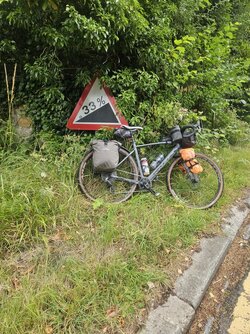
My 1x12 on my Whyte gisburn wasn't low enough for this one, hence my new bike with 2x11.
 

Attachments

  • 20250706_125400.jpg
    20250706_125400.jpg
    269.5 KB · Views: 0

midlandsgrimpeur

Senior Member
Trying to think why you couldn’t work out ratios. What was significantly different between your road and MTB?

Sorry, I meant rather that I struggled to understand that different ratios were required for MTB. Having ridden the likes of Wrynose and Hardknott with a 34-29 on a road bike, I assumed the same gearing applied to MTB terrain. I failed to take into account an extra 6kg of bike weight, 2.4" tyres and loosely packed dirt! I quickly realised why MTB cassettes had a 50t cog for steep stuff.
 
A 16% around Peterborough. Was it a bridge over a main road?

I doubt anything in the Petorborough area would be more than 8% but amazingly Cambridgeshire/Huntingdonshire not that far south of here had a few hills.
1772998999763.png
 

Shut Up Legs

Down Under Member
I'm late to the thread, but my take on it is: there's no such thing as too low a gear, you just ride with whatever you're comfortable using. Although too high a gear can cause problems with joints (knees & ankles).
 

rivers

How far can I go?
Location
Bristol
My road bike is 34/28 (and it still has rim brakes!). The only hill I haven't been able to get to the top of locally with that gearing is King Alfred's Tower.
My gravel bike is 40/51 for everyday use (though I might swap the 40 for a 42 or a 44, we'll see). For bikepacking, I've just purchased Ratio Tech's 34t GRX chainring- so 34/51 for bikepacking. That should get me up most things loaded.
 

midlandsgrimpeur

Senior Member
I'm late to the thread, but my take on it is: there's no such thing as too low a gear, you just ride with whatever you're comfortable using. Although too high a gear can cause problems with joints (knees & ankles).

Interestingly (well, to me at least!), I have recently switched from 170mm to 160mm cranks. I am only about 3-4 weeks in but I am already noticing this is having a significant positive effect on knees/joints and muscle stiffness. I now suspect crank length has a far greater impact on knees and joints than gear selection, as the leverage required for too long a crank (relative to the individual) is arguably where the greatest strain occurs.
 
Last edited:

All uphill

Still rolling along
Location
Somerset
Interestingly (well, to me at least!), I have recently switched from 170mm to 160mm cranks. I am only about 3-4 weeks in but I am already noticing this is having a significant positive effect on knees/joints and muscle stiffness. I now suspect crank length has a far greater impact on knees and joints than gear selection, as the leverage required for too long a crank (relative to the individual) is arguably where the greatest strain occurs.

I find this interesting, too. I've experimented with just about everything else, but never played with crank lengths.

A shorter crank means a greater force for any given situation, so does the improvement in knees come from reduced articulation of your joints, do you think?
 

midlandsgrimpeur

Senior Member
I find this interesting, too. I've experimented with just about everything else, but never played with crank lengths.

A shorter crank means a greater force for any given situation, so does the improvement in knees come from reduced articulation of your joints, do you think?

This will explain the biomechanics of it far better than I ever could! Julian, along with Phil Cavell, runs Cyclefit and is a pretty knowledgeable guy,. They have done the bike fitting for a number of pro teams over the years.

https://www.cyclefit.co.uk/journal/short-cranks-better-pedalling

The gist is that shorter cranks open up the hip and knee angle which reduces sheering stress and force at the top of the pedal stroke where the greatest dead spot is, and increases torque at the bottom of the pedal stroke, as the pedal is now effectively a shorter distance of travel.
 
Top Bottom