I think I may have a trace of rust...

Page may contain affiliate links. Please see terms for details.

C R

Guru
Location
Worcester
Would this be any good?
https://ebay.io/m/oCb3Ge
 

wafter

I like steel bikes and I cannot lie..
Location
Oxford
Oxalic acid doesnt harm the good metal -or paint - in the slightest.
I think all acids will attack the metal to an extent - it's just a case of how long this takes based on how strong they are; and hence how much margin of error you have before it becomes problematic.

Would that be good as a post-acid treatment? And presumably for the less serious frame rust elsewhere. I'd prefer the least aggressive route that will actually work. Would this survive the daily rough 'n tumble, or might it just wash off? In which case, I don't know, some kind of varnish? Any thoughts appreciated.
I'm not sure - if you're removing the rust I think you want as robust-a-finish as possible; i.e. a decent paint but this brings us back to the practical issues of prep and application in my last post. I think really it needs to be one of two extremes - remove all corrosion and fully refinish the frame (or at least the affected area) to a high standard (which has always been difficult; probably harder still now with environmental regs on consumer paints) or impregnate the rust with something that's going to stop it getting worse.

I'd caution against WD40 as over time the solvent evaporates off and leaves a tough, sticky residue that you probably don't want in your seatpost tube.

FWIW I've apparently had success applying a softened wax to the latch on my garden gate - the galvanising on which had failed allowing surface rust to develop; however left in the sun the wax has melted, wicked into the rusty surface and now appears stable..

Since the frame's clearly never going to be a minter (and being a working bike there's an arguable benefit to leaving it looking tatty) I'd be more inclined to largely leave the rust as-is and try to take measures to prevent it getting worse. That said if you do treat it with an oil / wax preservative that will limit you to mechanical rust removal in future as it will prevent chemical treatments from working.
 

Drago

Legendary Member
Location
The Urban Fringe
Im a physics man rather than a chemistry type geezer, but my limited understanding is that oxalic acid chemically reacts with oxides, so clean metal is left alone. Certainly in my personal experience it has never visibly etched clean steel or caused even the slightest visible damage to paint.
 

Brandane

Miles cannot be done unless moving!
Location
Costa Clyde.
And spraying WD-40 into all the tubing sounds like a really good idea.

If you're serious about spraying into the tubing, I would suggest that you follow (motor)bikers example and use ACF50 rather than WD40. It is far more durable, and better at rust prevention too!

Motorcycle | ACF-50 https://share.google/jkP2YARt9asTlPqRr
 
OP
OP
swee'pea99

swee'pea99

Squire

Thanks, I did spot that on my searches, but, sad as it sounds, I baulked at the nine quid for a lot more than I'll ever need when I was after a couple of quid's worth of basic powder. I like basic powders that do basic things well. Hence the citric acid under the sink, which, thanks to AI I now find I can use - and how to do it:
IMG_20260724_135336_202.jpg


Excellent! I shall give that a go and report back. As for the afters, again, while I'd like to protect the bike from future actual damage/corrosion, I don't think I need anything too extreme. The WD40 strikes me as a good cheap & cheerful solution for the tube interiors. If the solvent evaporates and leaves a sticky residue, that sounds fine to me. It's a barrier. Which, let's face it, is more than it's had for the last 50+ years. The outside, I'm not so sure. Again, I hate to sound cheap (I am) but ACE and Buzzweld, though I'm sure they're great, feel a bit like overkill for a tatty frame which has come through fifty+ years of neglect commendably unscathed, and will hopefully be good for 50 years more with just a little TLC. Even just decent car wax maybe? I don't know. But many thanks for all suggestions - all excellent grist to the mill!

Anyway, that's for tomorrow. I have paste to make!
 

Moon bunny

Dame of the trees.
I hear boiled linseed oil is favoured for "sympathetic" protection but I've not tried it.
Not nowadays, vegetable oils have been found to turn acidic and attack the metal they were supposed to preserve.
Tannic acid, found in various proprietary products (no need to brew up), well washed off, followed by Renaissance wax is the museum standard.
 

Fastpedaller

Veteran
Location
Norfolk
Im a physics man rather than a chemistry type geezer, but my limited understanding is that oxalic acid chemically reacts with oxides, so clean metal is left alone. Certainly in my personal experience it has never visibly etched clean steel or caused even the slightest visible damage to paint.

I'm in agreement. It seems there can be 2 approaches (is that the correct word?) to rust - rust removal and rust conversion. I've used both over the years, and both work but it does indeed depend on what subsequent coating are applied. If not using paint (ie putting heavy wax /oil over I'd suggest rust conversion (oxalic acid) or similar would be best - only my opinion though :whistle:
 

wafter

I like steel bikes and I cannot lie..
Location
Oxford
Not nowadays, vegetable oils have been found to turn acidic and attack the metal they were supposed to preserve.
Tannic acid, found in various proprietary products (no need to brew up), well washed off, followed by Renaissance wax is the museum standard.

Thanks - didn't know that!
 
OP
OP
swee'pea99

swee'pea99

Squire
Well, so far so good!

Made up a 10% solution of citric acid (5ml, in 50ml of water - the smallest amount I reckoned I could make with any confidence in the ratio), then mixed it into a ceral spoon of plain flour. Didn't form a paste; more like a pizza dough - stretchy and clingy. Which proved excellent for applying, making it easy to work it into all nooks and crannies, using a toothbrush.

bike 1.jpg


Added a bit of cling film, left it a couple of hours and rinsed off and....

bike 2.jpg


I'm quite pleased with that! Leave it to get bone dry, remove the bubbled paint, then...I'm thinking maybe car wax....but no. Apparently this is a poor idea:

1784911293671.png


Rust-converter. Oo-er. This is all more complicated than I imagined. Oh well, that does sound like something really does need attending to. Off to find some rust converter...
 

Fastpedaller

Veteran
Location
Norfolk
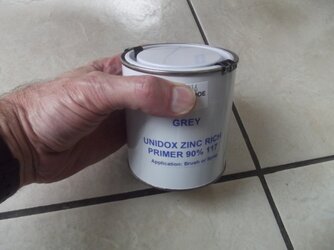
I can recommend this zinc primer I bought a few years ago. When the seller handed it to me he continued to hold on to the can...... It then became clear why he did this IT'S VERY HEAVY for a small tin of paint. Customers drop them if he doesn't do this :ohmy:
The zinc content is very high. Before use it takes about 10 minutes of constant stirring with a heavy-duty stirrer (I use a stainless steel strip) to get a good even consistency
 

Attachments

  • zincpaint.JPG
    zincpaint.JPG
    185.6 KB · Views: 0
OP
OP
swee'pea99

swee'pea99

Squire
I can recommend this zinc primer I bought a few years ago. When the seller handed it to me he continued to hold on to the can...... It then became clear why he did this IT'S VERY HEAVY for a small tin of paint. Customers drop them if he doesn't do this :ohmy:
The zinc content is very high. Before use it takes about 10 minutes of constant stirring with a heavy-duty stirrer (I use a stainless steel strip) to get a good even consistency

I love things like that. It always hacks me off in movies when you see the gang loading the gold bullion into the back of the van, like they're handling house bricks, when a standard bullion bar weighs twelve and half kilos - heavier than a watering can filled to the brim. Gold is also VERY HEAVY!

I won't be getting any zinc primer tho. Again, though it would probably be part of an 'ideal' solution, I think it would be a bit OTT for my needs, which are basically to stop the existing rust in its tracks, and discourage new rust. And I think I'm just about there....

1785147424200.png


Rust removed, remaining traces 'converted' (whatever that amounts to), and the whole shebang coated with (you're going to love this!) clear nail varnish. Why not? It seals. I'd have used regular varnish if I'd had any to hand, but I don't see why nail varnish shouldn't do the job just as well. Google says it'll need re-applying in a few months. Fine. I can re-apply now & again. And it's not like it's going to be exposed to any impact damage, being tucked away under the seat like that. So I think I'm good now. Looks a bit of a shocker, but down here in that there London we call that scrote-proofing. So far so good!

Thanks all.
 
Last edited:

All uphill

Still rolling along
Location
Somerset
In 2018 I had a frame resprayed by Argos. Sadly the paint chipped very easily, so, after I dried my tears I bought a bottle of Super drug nail varnish.

Eight years later the varnish has proved to be considerably tougher than the enamel. I've not needed to touch it up at all.

Next time I want to paint a frame it's going to be nail varnish all the way.
 

Fastpedaller

Veteran
Location
Norfolk
I love things like that. It always hacks me off in movies when you see the gang loading the gold bullion into the back of the van, like they're handling house bricks, when a standard bullion bar weighs twelve and half kilos - getting on for the weight of a 12-bottle box of wine. Gold is also VERY HEAVY!

I won't be getting any zinc primer tho. Again, though it would probably be part of an 'ideal' solution, I think it would be a bit OTT for my needs, which are basically to stop the existing rust in its tracks, and discourage new rust. And I think I'm just about there....

View attachment 816448

Rust removed, remaining traces 'converted' (whatever that amounts to), and the whole shebang coated with (you're going to love this!) clear nail varnish. Why not? It seals. I'd have used regular varnish if I'd had any to hand, but I don't see why nail varnish shouldn't do the job just as well. Google says it'll need re-applying in a few months. Fine. I can re-apply now & again. And it's not like it's going to be exposed to any impact damage, being tucked away under the seat like that. So I think I'm good now. Looks a bit of a shocker, but down here in that there London we call that scrote-proofing. So far so good!

Thanks all.

That looks a lot better - I wouldn't expect anyone to buy the zinc primer just for a one-off. I've used it (on the underside of a steel fuel tank on my car) and it certainly works.
Does the seatpin on your bike move? I'd take the opportunity of removing it and greasing if you haven't already done so.
p.s. I saw a bike frame damaged when someone undid the allen key (like yours above?) because they didn't realise one side had a 'tag' into a slot (if that makes sense), and they took an allen key to the other side and turned, when they should have used an additional AK on the 'fixed' side.
 
Top Bottom